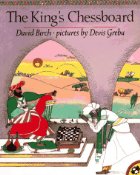
在古老的印度,國王為了要獎賞服侍他的智者,便要智者提出想要的獎賞,智者認為能繼續服侍國王便是最大的獎賞,但國王礙於面子堅持要智者提出實際的賞物,於是智者便請求國王每天可以賜給他比前一天多一倍的米,看似簡單的要求,最後又會有什麼出人意表的結果呢?值得深思的一本書。適合6歲以上兒童閱讀。The king of the title is an Indian potentate who receives a service from a wiseman and insists on repaying the fa vor. The wiseman finally requests the familiar mathematical puzzle of the chessboard, on whose first square is placed a single grain of rice, on whose second square is placed two grains, four on the third square, and so on. The king, who is too proud to admit that he can't calculate the sum total of the gift, foolishly grants the wish, at least until it becomes clear that it will wipe out his stock. Finally, in spite of his pride, he takes back his repayment, justly em barrassed because of his stupidity and the wiseman's obvious generosity in not wanting a repayment in the first place. The story may be recognizable to older readers familiar with mathemati cal puzzles, but it will be new to begin ning mathematicians and readers. The tale is simply told, and the primitive watercolor pictures, with some bright jewel tones to set off the otherwise an tique cast of the colors, aptly comple ment this original folktale. Although the text is too complicated for begin ners to master on their own, this picture book is so masterfully told that they will listen to it attentively. Ruth K. MacDonald, Department of English, New Mexico State Univ . , Las Cruces
Copyright 1988 Reed Business Information, Inc.
|